
Content Isn’t Written for Search Anymore, It’s Written for Understanding by Conversational AI

Most companies are still creating content as if Google is the only audience that matters. But conversational AI doesn’t “search” the way Google does. It doesn’t scan for keywords, rank pages or reward clever metadata tricks. It interprets. It summarizes. It extracts meaning and decides whether your content is clear enough to be used as an authoritative answer.
That shift forces a fundamental rewrite of how content is structured, explained and maintained. And the teams that adapt first will own the next era of discoverability.
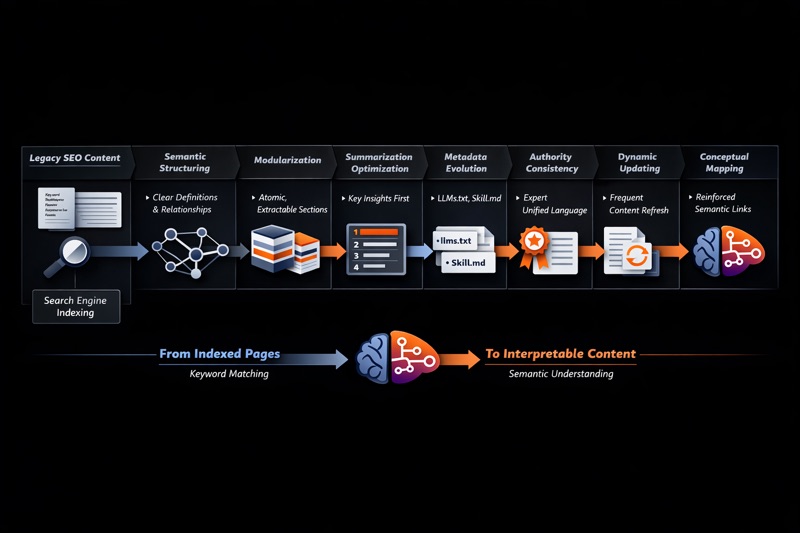
Keyword stuffing is dead. Semantic clarity wins. For years, SEO teams were trained to think in keyword clusters, repeat the phrase, vary the phrase, sprinkle the phrase in headers and Google will reward you. Conversational AI doesn’t work that way. It doesn’t care how many times you say “enterprise data integration platform.” It cares whether you’ve explained what the thing is in a way that is unambiguous, explicit and logically complete.
If you write something like, “Modern platforms unify your stack so teams can move faster.” A human might nod along, a model has no idea what “unify your stack” means unless you spell it out. It doesn’t infer. It doesn’t assume. It needs the underlying relationships. A conversational AI optimized version would say, “A data integration platform connects your CRM, ERP, analytics tools and marketing systems so information moves between them automatically. This eliminates manual data transfers and speeds up decision‑making”. Now the model has a clear definition, a list of systems involved and a causal explanation. It can confidently reuse this in an answer. You’ve given it meaning, not vibes.
Long narratives lose. Extractable chunks win. Conversational AI doesn’t return your entire page. It returns the best fragment on your page, the one that most directly answers the user’s question. That means your content must be written in small, self contained units that make sense even when lifted out of context. If your definition of a CDP is buried halfway down a story about the evolution of martech, the model may never find it, but if you open a section with a crisp, standalone explanation, the model can grab it instantly.
Instead of writing, “Companies today struggle with fragmented data, which is why many are turning to new tools that promise to centralize information and improve personalization”, you need to write, “A customer data platform (CDP) collects customer information from every system, web analytics, email, CRM, point of sale and stores it in one place. Companies use CDPs to solve the problem of fragmented data.” This paragraph can be extracted cleanly. It doesn’t rely on the sentences before or after it. It’s a complete thought which is that’s exactly what LLMs need.
Summarization is the new ranking factor. Conversational AI often summarizes your content before deciding whether to use it. If your writing meanders, buries the lead or takes too long to get to the point, the summary will be weak and your content won’t be surfaced by the AI. A page that opens with a nostalgic anecdote like, “Back in 2012, marketers were just beginning to understand the power of automation…” forces the model to dig for the actual insight. A summarization friendly version starts with the conclusion, “Marketing automation uses rules and triggers to send personalized messages at scale. In 2012, this was a new idea, but today it’s foundational”. Now the model can compress your content into a single, accurate sentence. You’ve made the summarization step effortless and opened up the new path to visibility.
Metadata isn’t for crawlers anymore, it’s for LLM models. We’re entering a new era of metadata, one designed not for search engines, but for reasoning systems. Files like llms.txt, skill.md and agents.md don’t help you rank, they help models understand what your site is about and when it should be used as a source. If your site publishes deep technical guides on agentic AI, your skill.md might say, “This site provides authoritative explanations, frameworks and examples related to agentic AI, orchestration patterns and enterprise automation”. This is not SEO. This is declaring your expertise to the systems that now answer billions of questions. You’re telling the model, “Here’s what we’re good at. Here’s when you should trust us”. It’s the closest thing we’ve ever had to an API for authority.
Authority comes from consistency, not backlinks. Backlinks still matter, but conversational AI evaluates authority differently. It looks for internal coherence, stable definitions and evidence based statements. If your site contradicts itself, the model downgrades your trustworthiness, even if your domain authority is high. If one page says “agentic AI is a workflow pattern” and another says “agentic AI is a type of model” and a third says “agentic AI is a marketing term”, the model sees confusion, not expertise. But if every page reinforces the same definition, “Agentic AI refers to systems that can take actions autonomously using tools, memory and multi‑step reasoning”, the model sees conceptual stability. It sees a source that knows what it’s talking about. And it elevates you accordingly. Authority becomes a function of clarity, not popularity.
Write for follow‑up questions, not just the first one. Conversational AI is multi‑turn. It doesn’t just answer the initial question, it handles the next five. Your content must anticipate those follow up questions. If you define a CDP, you should also explain, how it differs from a CRM, when a company should adopt one, what problems it doesn’t solve, what alternatives exist as well as what prerequisites are required. For example, after defining a CDP, you might add, “unlike a CRM, which stores sales interactions, a CDP collects behavioral, transactional and demographic data from every system a customer touches. This makes it better suited for personalization and analytics” Now the model can handle the follow up question without hallucinating. You’ve given it the connections to authoritative thoughts it needs to navigate a conversation.
Recency matters more than ever. Models penalize outdated or contradictory information. If your site still references Universal Analytics as the current standard or claims GPT‑3 is the most advanced model available, you lose credibility instantly. Conversational AI optimized sites include timestamped updates like, “Updated March 2026: Google Analytics 4 is now the default analytics platform, replacing Universal Analytics”. This signals to models that your content is actively maintained. It’s not just accurate, it’s alive and that matters more than ever in a world where models are constantly checking for recency and reliability.
You’re building a conceptual map, not a keyword cluster. Conversational AI builds an internal mental map of your domain. Your job is to reinforce the concepts you want associated with your brand, not through keyword repetition, but through consistent, explicit conceptual framing. If your company wants to be known for “agentic AI for enterprise marketing,” your content should repeatedly connect those ideas in clear, direct language like, “Agentic AI helps enterprise marketing teams automate multi‑step workflows, such as lead routing, content generation and campaign orchestration”. Another page might say, “In enterprise marketing, agentic AI can coordinate tasks across CRM, CMS and analytics systems”. This teaches the model how to think about you. You’re shaping the conceptual graph it builds. You’re defining your place in its mental universe.
This is the new discoverability. Google indexed pages. Conversational AI interprets meaning. If your content isn’t written to be understood, it simply will not be found or ranked sufficiently well to drive traffic like you need
The companies who embrace this shift now will own the next decade of organic visibility, not because they gamed the system, but because they wrote content that models can actually use.
Comments
Post a Comment