
How to Write Effective AI Prompts
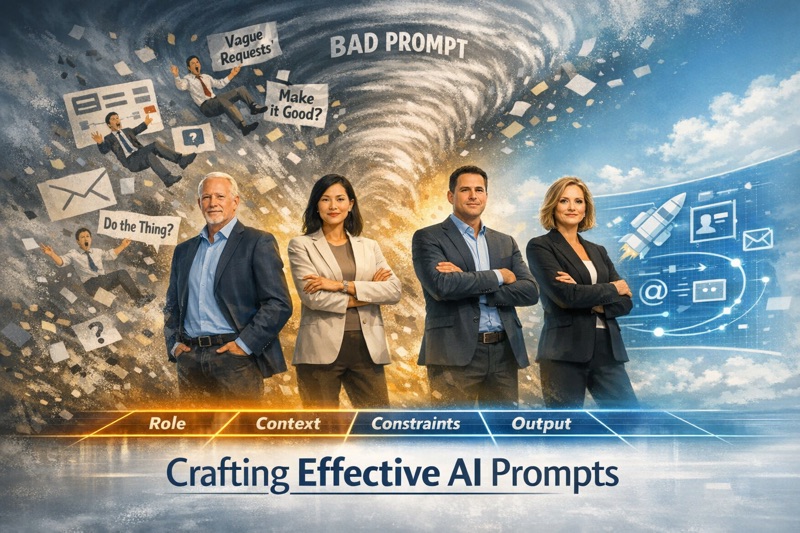 My recent struggles with trying to get an AI to render a graphic for a presentation is was putting together and even when I pointed out that AI had failed to do the basic things I asked, it even admitted it was wrong when I pointed out inconsistencies in the things it was doing and reporting when I asked it questions in searching for a way to get the AI to understand what I wanted. And I’m not sure that it wasn’t even a little bit remorseful over its failures when it told me I had hit my image generation limit for this session and I questioned it on its inconsistencies, it started rendering the images for me again, even though I was out of credits or whatever limit I hit and even still it failed to generate what I was asking for.
Once again, it’s not what you say, it’s how you say it and who the person is that you’re casting onto the AI. Why detail, context and constraints matter more than ever
The most effective AI prompts share a common DNA, they give the model clarity, constraints, context and criteria for success. Whether you’re generating complex Java code, configuring Adobe Journey Optimizer, designing a cubist self‑portrait or architecting a rocket to Mars, the underlying mechanics are the same. The more precisely you describe the intent, inputs, outputs and conditions, the more reliably the AI produces high quality results.
This article introduces a practical framework for writing prompts that consistently deliver expert‑level output and provides detailed, real world examples across technical, creative and engineering domains.
The Four Elements of a High‑Performance Prompt
• Role & Perspective define who the AI should “be” (e.g., senior Java engineer, Adobe architect, aerospace systems designer, museum‑trained cubist artist).
• Task & Intent describe exactly what you want done and why.
• Inputs & Constraints provide all relevant details like data, rules, requirements, style, tone, libraries, formats, safety constraints or system limitations.
• Output Format & Quality Bar specify the structure, level of detail and what “good” looks like.
Each example below uses this structure so readers can see how to apply it to their own work.
Example 1: High Fidelity Prompt for Enterprise Grade Java
Prompt:
“Act as a senior Java engineer specializing in high‑performance, thread‑safe backend systems. Write a complete Java class that implements a rate‑limited, in‑memory job scheduler. Requirements:
• Must support scheduling recurring and one‑time jobs
• Must enforce a configurable rate limit per job type
• Must be thread‑safe using java.util.concurrent primitives
• Must expose methods to add jobs, remove jobs and query next run time
• Include Javadoc for all public methods
• Include a short explanation of design decisions, tradeoffs and potential failure modes
• Output should include:
• Full Java class
• Example usage snippet
• Notes on scalability and extension points.”
This prompt works because it defines role, intent, technical constraints, libraries, API surface and output structure.
Example 2: Configuring Adobe Journey Optimizer to Send an Email
Prompt:
“Act as an Adobe Journey Optimizer solutions architect. Provide step by step instructions to configure a journey that sends a promotional email to a specific mailing list. Requirements:
• The mailing list is stored in Adobe Experience Platform as a segment named SpringPromo2026.
• The email template already exists in AJO under the name Spring_Offer_Template.
• Include steps for:
• Validating the segment
• Creating the journey
• Adding the email action
• Mapping personalization fields from AEP profile attributes
• Setting frequency caps
• Testing and publishing the journey
• Include screenshots descriptions for each major step (no images needed, just text descriptions).
• End with a checklist of common misconfigurations and how to avoid them.”
This prompt works because it gives system context, asset names, workflow steps, validation requirements and quality checks.
Example 3: Creating a Cubist‑Style Self‑Portrait for Artistic Image Generation
Prompt:
“Act as a museum‑trained cubist painter inspired by Picasso’s 1909–1914 analytic period. Generate a detailed prompt for an AI image model to create a cubist self‑portrait of me. Include:
• Fragmented geometric planes
• Muted earth tone palette (umber, ochre, slate gray)
• Multiple simultaneous perspectives (frontal & profile)
• Angular facial features with exaggerated asymmetry
• Background composed of intersecting planes
• Lighting that emphasizes sharp edges and faceted surfaces
• Style references: Picasso’s Portrait of Daniel-Henry Kahnweiler, Braque’s Woman with a Guitar
• Output the final prompt in a single paragraph suitable for image generation models.”
This prompt works because it specifies artistic period, technique, color palette, composition, references and output format.
Example 4: Designing a Rocket to Mars
Prompt:
“Act as an aerospace systems engineer specializing in interplanetary mission architecture. Produce a conceptual design for a two‑stage Mars transfer vehicle. Requirements:
• Mission profile: crewed mission, 4 astronauts, 180 day transit.
• Include propulsion options (chemical, nuclear thermal, hybrid) with pros/cons.
• Provide mass budget estimates for each subsystem: propulsion, life support, radiation shielding, habitat, avionics, consumables.
• Include delta‑V calculations for Earth departure, Mars transfer and Mars orbital insertion.
• Provide a diagram description (text only) of the vehicle layout.
• End with a risk matrix covering thermal, radiation, propulsion and life‑support failure modes.”
This prompt works because it defines mission parameters, engineering constraints, calculations, subsystems, risk analysis and output structure.
Bringing It All Together
Across all four examples, the pattern is consistent:
• Define the role you want the AI to assume.
• Provide rich, specific context.
• Add constraints that shape the solution.
• Specify the format and depth of the output.
• Describe what “excellent” looks like.
Now copy, paste and run these yourself and see if you get what you were expecting.
Comments
Post a Comment